
The Complete Guide to Western Dressage
Western Dressage, rapidly gaining popularity in the equine community, blends traditional Western gear with classical dressage elements. Renowned trainer Tim Christensen introduces this unique discipline, tracing its origins and discussing his transition from all-around riding to Western dressage. In his instructional series, he delves into key concepts such as utilizing the letter X to delineate arena sections, mastering 20-meter circles, and navigating dressage patterns with precision. Christensen emphasizes proper techniques for circles, loops, and serpentines, guiding riders through exercises to enhance suppleness, transitions, and halts. From basic tests to maneuvers like turns on the haunches and forehand, he provides valuable insights into achieving harmony and precision in Western dressage performance.

-
Introduction to Western Dressage
Western Dressage is one of the fastest growing disciplines in the horse indusrty and is being offered by many associations. This unique style of riding combines the traditional Western gear with the elements of traditional dressage. Multiple world champion trainer Tim Christensen introduces the d...
-
Getting to Know X
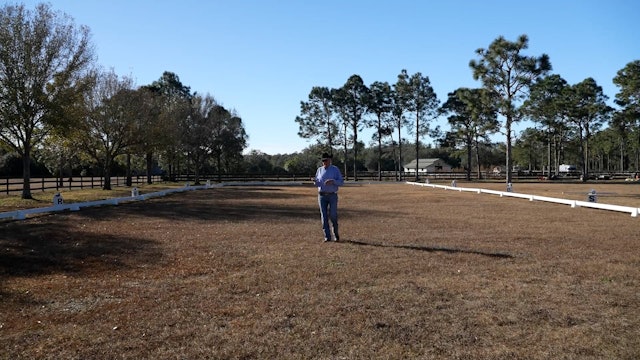
Tim Christensen introduces the letter X and explains how it is used in Western dressage. He shows how it helps break the arena up into three separate parts and where X actually is in the arena.
-
Introduction to 20 Meter Circles
Tim Christensen explains where in a dressage arena you will use a 20 meter circle. He shows which letters you will use to measure your circle and explains some common mistakes made with a 20 meter circle.
-
Introduction to Quarter Lines
Learn where a quarter meter line is supposed to be ridden in a Western dressage pattern.
-
Visuals of a 20 Meter Circle
Tim Christensen shows the specific parts of a 20 meter circle and where it should be ridden during a Western dressage pattern. He gives a visual of how the circle should look and gives helpful tips to achieve this in your pattern. Tim also explains what the judges look for in a 20 meter circle.
-
20 Meter Circle at B or E
Tim Christensen goes over a circle at B or E and explains what it will look like during a Western dressage pattern. He walks through where the circles should be ridden, which letter you will start at, and the exact points of the arena that you will ride the 20 meter circle.
-
20 Meter Circle at X
Tim Christensen explains where a 20 meter circle will be ridden when called for in a Western dressage pattern. He demonstrates the exact points you should hit when riding the circle and explains what the circle should look like.
-
Introduction to a 20x40 Arena
Tim Christensen explains how X can help you shape and place your 10 and 20 meter circles.
-
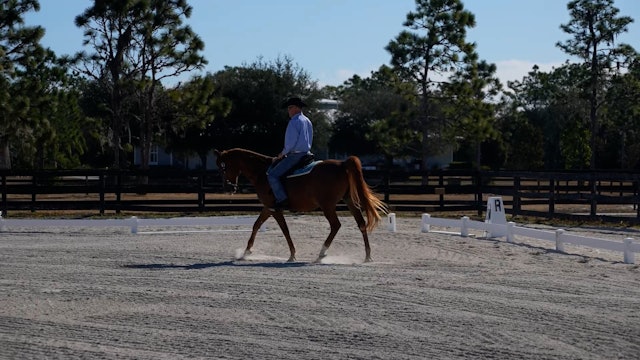
Different Types of Saddles
Tim Christensen discusses the different types of saddles that may be used in Western dressage.
-
Geometry of Circles
Tim Christensen demonstrates how to correctly ride 20 meter circles tracking left at E, A, and B. He explains where each circle should begin and end in order to be the correct size and shape.
-
Learning the Basics of Loops
Tim Christensen explains the basics of loops. He demonstrates some of the loops you may see in the intro tests and discusses how knowing the geometery of the ring can help you ride them correctly.
-
Demonstrating Serpentines on a Quarter Line
Tim Christensen demonstrates riding serpentines on the quarter line. He explains where to turn, where to switch the bend, and other points to keep in mind while riding the serpentine.
-
The Dressage Pyramid
Tim Christensen demonstrates riding serpentines on the quarter line. He explains where to turn, where to switch the bend, and other points to keep in mind while riding the serpentine.
-
Working on Circles with a Non Pro
Learn how the dressage pyramid can help you train and get a feel for Western dressage. Tim Christensen explains the blocks of the pyramid—rhythm, relaxation, connection, impulsion, straightness, and collection.
-
Focusing on Round Circles with a Non Pro
Tim Christensen helps one of his students riding an Arabian/Trakehner cross work on 20 meter circles in to 20x40 arena. He uses the toy train analogy to help explain how to keep roundness in the circles.
-
Using Cones to Improve Circles
Tim Christensen discusses some of the problems that can arise when riding circles in the Western dressage. He helps one of his students troubleshoot and offers her advice on how to improve the roundness of her circles.
-
Using Your Seat to Steer
You can use cones to improve the roundness of your circles.Tim Christensen explains where to place the cones and how to ride the exercise while his student demonstates.
-
The Spiral Exercise
Tim Christensen has his student demonstrate how you use your seat to steer.
-
The Left/Right Drill
Tim Christensen has his students demonstrate the spiral exercise. This exercise helps create rounder circles and while making your horse more flexible.
-
The Left/Right Warm Up
Tim Christensen has his students demonstrate the left/right drill. He helps them work through the exercise, focusing on round circles, switching the bend, and helping the students support their horse's outside shoulder.
-
Lower-Level Gaits and Maneuvers
In this video, Tim demonstrates the left/right drill that he had his non pro riders do in the last video. He shows you exactly what the circles are supposed to look like, and explains why this is a great drill for warming up your horse.
-
Working Your Horse Through a Distraction
The rhythm and cadence of every footfall is important in dressage. Tim Christensen explains the origin of dressage and why you need to pay attention to your horse's footfall in Western dressage lower-level gaits and maneuvers.
-
An Introduction to Transitions
Watch as Western dressage trainer Tim Christensen demonstrates his technique for working your horse through a distraction.
-
Introduction to the Western Dressage Walk
Western dressage trainer Tim Christensen explains the importance of transitions in a dressage test. He walks you through the basics of transitions and demonstrates riding a correct downward transition.